
Starting your journey toward a PMI Certification is a smart career move. Basically figuring out where to begin can feel overwhelming. However, for many, rightfully, the first major milestone quite is the Certified Associate in Project Management (CAPM) exam. From a theoretical standpoint, it implies this guide cuts through the confusion. We’ll walk quite you through a straightforward. Step-by-step strategy where the smart use of a CAPM Practice Test becomes your biggest advantage for earning that crucial credential.
Unlocking PMI Certification: Why It Matters
Lets talk about why youre here and in the world of project management, a PMI certification is more than just a line on your resume. Its that stamp of approval from around the globe that says you really have a handle on what you’re doing.
Having passed the CAPM shows you’re serious about putting in the hard work and getting a solid foundation of knowledge under your belt, and that makes you a more attractive candidate when applying for jobs. But starting with this focused PMI certification is actually a pretty smart way to build up a foundation of credibility from the very start.
CAPM Demystified: Understanding the Certification
What Exactly Is the CAPM?
The Certified Associate in Project Management thats the Certified Associate in Project Management is entry level credential thats offered by the Project Management Institute (PMI). It shows that you’ve got a good handle on the fundamental knowledge and processes that underpin PMI’s core standards, and that you can talk the talk in project management speak.
Who is this for?
Its perfect for anyone with a secondary degree we’re talking high school diploma or equivalent here. And youve either got to have 1,500 hours of project experience under your belt or have got 23 hours of some sort of formal project management training on the books. The education route makes it a heck of a lot more accessible for people just starting out.
What’s on the exam?
The CAPM exam is a pretty thorough test of your project management knowledge. It’s divided up into four key areas:
- Project Management Fundamentals and Core Concepts: This is the absolute basics of project life cycles, roles and planning – and if you can’t get this right then perhaps project management is not for you.
- Predictive, Plan-Based Methodologies: This is all about understanding the traditional, waterfall-style project approaches the ones that aim to stick to a nice, neat plan.
- Agile Frameworks/Methodologies: This is where you get to learn the foundational knowledge of things like Scrum and Kanban the adaptive approaches that are all the rage today.
- Business Analysis Frameworks: Here you’re looking at the core concepts that underpin understanding requirements and stakeholder needs the bits that are critical to getting off on the right foot.
Practice Makes Perfect: The Role of CAPM Mock Tests
This is at the heart of a smart strategy when it comes to studying for the CAPM exam. Rather than just passively reading a guide, taking a CAPM practice test is an active and strategic way to get ready. They really get you moving on to real learning fast. Taking practice tests forces you to do more than just recognise the knowledge, it makes you apply it too. These tests ask you scenario-based questions in a way the real exam will: “What should you do first?” or “What’s the best response to give?”
A good practice test will actually train your brain to think in a way that’s just like the real thing, getting you away from just memorising stuff and towards actually using it. Consistently taking a CAPM practice test will really show you up, clearly showing you where your areas of strength and weakness are.
The CAPM exam is 150 questions over three long hours thats a marathon. Getting in the habit of sitting a full-length practice test on the clock is what builds up the focus and endurance you need to make it to the end. It also takes away a lot of that last-minute anxiety because you know what to expect the format and pace of the test is no longer going to be a source of worry for you.
Picking the Right CAPM Practice Test: A Smart Approach
Not all practice resources are created equal using subpar or out of date materials can completely throw a wrench into your prep.
What to Watch Out For
- Make sure they’re aligned with the Exam Content Outline (ECO): We’re talking about the latest version, the one that was updated in 2023. Anything older and you’re basically missing out on huge chunks of the current content, like Agile and Business Analysis – no good.
- Detailed answer explanations are a must: The score is just the start, the real value comes from understanding why an answer is right or wrong and the best resources give you crystal clear rationales that reference the core guides.
- Get a feel for the actual test format: The CAPM exam uses a range of question types, including multiple-choice, matching and others. Your practice should be pretty well rounded to reflect this.
Where to Find Good Ones
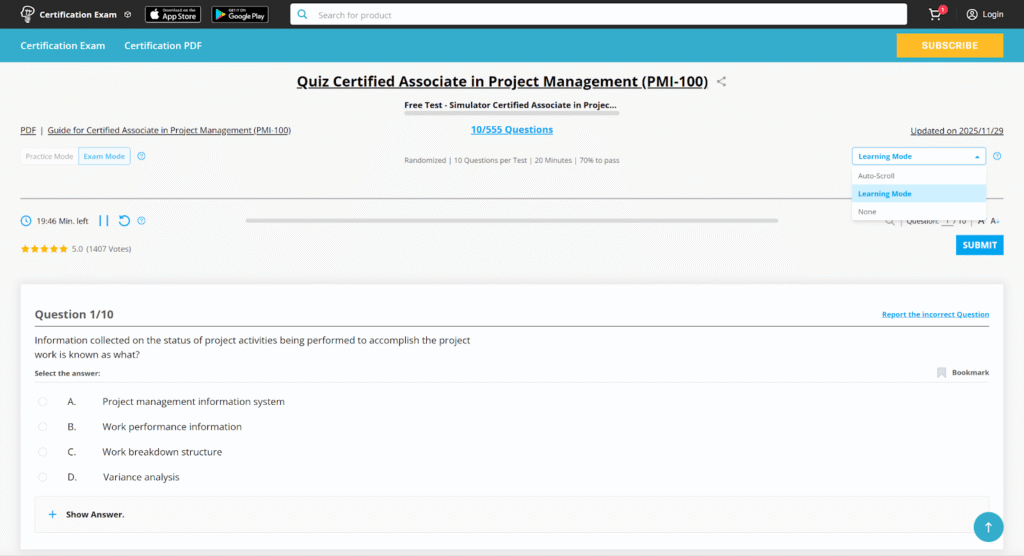
Look to PMI Certification own resources, their authorized training partners or other reputable test prep platforms. If you want the whole shebang, some people swear by dedicated exam-aligned platforms like Certification-Exam prep, which is designed to mimic the test environment just make sure whatever you choose is good to go and trustworthy.
Crafting a Study Roadmap for CAPM Success
A goal without a plan is pretty much just a pipe dream, you need to have a schedule in place.
Design a real timeline, a solid plan usually takes 8 to 12 weeks, but that depends entirely on how many hours you’re devoting to studying each week. Be sure to block out specific times every week in your calendar, these study sessions are every bit as important as any other appointment you’ve got.
Integrating practice tests is key, and don’t save everything for the last minute. Weave them into your whole plan like this:
- In the first 4 weeks, after you’ve finished studying each section, take a 20-30 question quiz to see if you’ve really got it.
- Then from weeks 5-6 it’s time to take your first full length 150 questions practice exam under timed conditions, that’s your benchmark.
- From weeks 7-8, use your full exam results to figure out where you’re going wrong, go back and review those weak areas and take some more targeted quizzes.
- And in the final few weeks take 2-3 more full length practice exams, keeping your eye on a target score that you’re aiming to better with each one.
Keep an eye on how you’re doing by using a simple spreadsheet or a notebook to log your practice test scores and note down any areas where you keep getting stumped. It’s that kind of objective data that’ll let you make the adjustments you need to stay on track.
Proven Strategies to Maximize Practice Test Results
Taking the test is just the first half of the battle; the real trick is in the review that comes after.
Simulate Real-World Exam Pressure. When you sit down for a full-length CAPM practice test, make sure you get the experience right turn off your phone, keep an eye on the timer, and only take the breaks that you’re allowed. Getting used to that level of pressure will make a big difference when it counts.
Get to the Bottom of Your Mistakes. After every practice test, thoroughly review every single question not just the ones you got wrong, but all of them. Sort your mistakes into categories :
- Knowledge Gap: You didn’t have a clue about the concept or formula involved.
- Misreading the Question: You were in a rush or just didn’t fully understand what the question was asking.
- Process of Elimination Error: You narrowed it down to your top 2 options, but picked the wrong one.
Turn Mistakes into Knowledge. With every question you got wrong or had to guess on, write down in your own words the correct principle on a flashcard or in a “Fix-it” document. That document will become your most valuable study guide in the final days leading up to the exam.
Avoiding Common Pitfalls in CAPM Preparation
Knowing what not to do can be just as valuable as knowing what to do.
Don’t just memorise questions. This is one of the biggest pitfalls. Pure rote memorisation of practice test answers is a waste of time because the exam questions are always going to throw something different at you. When you use practice tests, focus on really getting stuck into the underlying concepts and question structures, not just trying to bank meaningless answers.
Don’t try to ignore the clock. If all you’ve ever practiced is untimed, you’ll freak out on exam day. You really do need to develop a sense of how long you should be taking over each question. A rough rule of thumb is to budget about a minutes worth of thinking time for each question. Don’t just shrug off the review session after a practice test. Most people waste their time by getting their score and then moving on.
Exam Day Mastery: Approaching the CAPM with Confidence
Your hard work has finally paid off & now you need to navigate this day. Here’s what you need to know. Manage your time like it’s your job. Keep an eye on your progress at all times & try to pace yourself. A good rule of thumb is to aim to have gone through 50 questions by the 1 hour mark, and 100 questions by the 2 hour mark. That leaves you a whole hour to go back over the tough ones and the ones you’re not so sure about, and to attack any questions you’ve flagged as tricky.
Don’t get bogged down on the ones that are giving you trouble, just flag them and move on. Keep your nerves in check. All that studying and practice you’ve done is what’s going to get you through this. Trust in the work you’ve put in & don’t get too rattled if things get tough.
After the Exam: Interpreting Results and Next Moves
You’ve clicked “Submit”: Now What Happens Next
Understanding Your Score Results: You’ll get a quick Pass/Fail result when you leave the test centre, but it’s only a few days later that you’ll receive a detailed report from PMI Certification, inside your email inbox. If you’ve passed, well done! You should be pretty proud of yourself – it’s a major step in getting your PMI Certification whether that’s what you’re after or just a first step. Your results report will show just how you did in each of the exam areas – and that’s valuable insight into where you still need to learn more.
If You Don’t Pass First Time Round: Don’t be too hard on yourself. If you don’t pass, the good news is that the score report is a treasure trove of information. It tells you exactly where you went wrong and which areas need more work. You get up to three goes within a year to get it right – so take a long hard look at your study plan, put in some intense studying on the areas that let you down and get back in there for another try just as soon as you feel ready.
Working Out Your Next Move: The CAPM usually lasts for five years. Don’t worry, you don’t have to do anything, but if you want to keep it you’ll need to collect some more Professional Development Units (PDUs) before it runs out. Think of it as the opening chapter in your ongoing journey in project management may be the next step up will be one of the more advanced PMI Certification in your sight.
Conclusion: Your Road to PMI Certification Success
Earning your first PMI certification is a game changer. It suddenly makes sense that all those doors are now open to you, it validates your skills in a way that means real something, and gives you a clear idea of where you’re headed in your career.
The thing is, using a CAPM practice test strategically is the one thing that’s really going to set you apart from the rest. It’s the difference between studying for a test and actually becoming a master of the material. Where other people get anxious about the exam, you can get a sense of confidence instead. So stay on track with your plan, learn from every misstep, and keep your eye on the prize.
