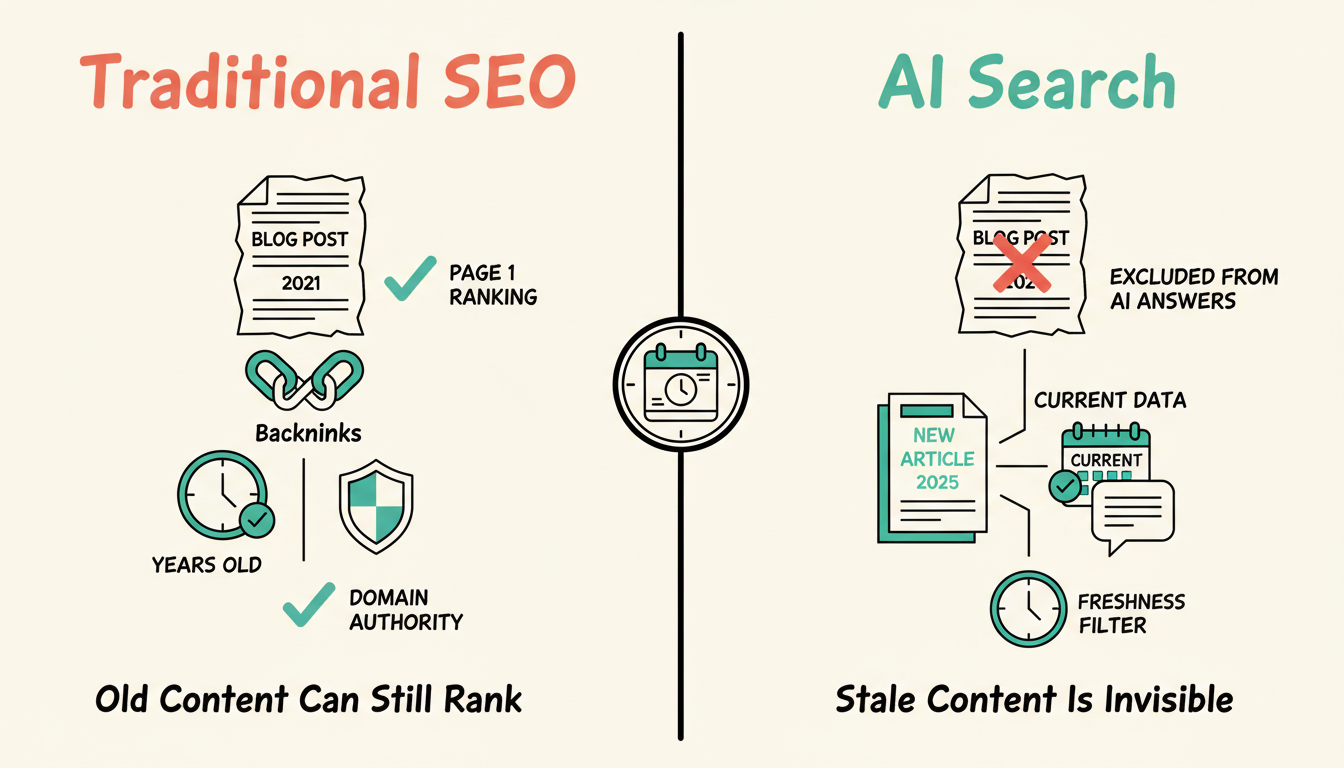
A blog post from 2021 can still rank on page one of Google. That same post will never appear in an AI-generated answer about current best practices. Answer engines punish stale content far more aggressively than traditional search algorithms do.
If your content strategy treats freshness as optional, you are optimizing for a system that is losing influence while ignoring the one that is gaining it.
How Traditional SEO and AI Search Treat Freshness Differently
Google uses hundreds of ranking signals. Freshness is one of them, but it competes with domain authority, backlinks, and content depth. A well-linked older page can outrank a newer one easily.
AI answer engines operate differently. They synthesize responses from the most current and relevant sources. When a user asks about a topic, the AI model prioritizes recent data, updated statistics, and current methodology. Outdated content gets excluded from the synthesis entirely.
In traditional SEO, old content can ride authority signals for years. In AI search, old content is invisible. Freshness is not a ranking factor. It is a qualification filter.
What Content Freshness Actually Means for AEO
It Is Not Just Updating Dates
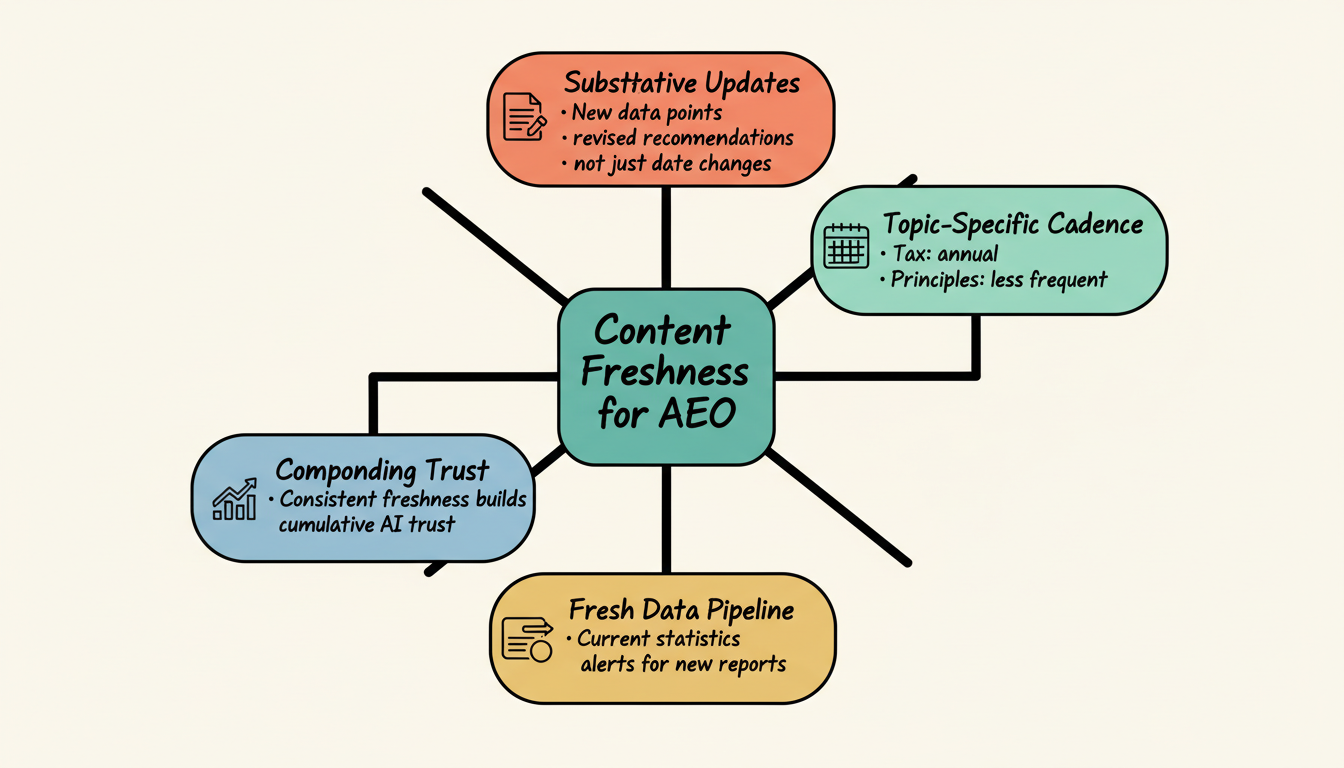
Some teams update the publish date on old articles and call it “refreshed.” AI models are more sophisticated than that. They evaluate whether the substance has changed: new data points, updated processes, revised recommendations.
Cosmetic freshness tricks do not work. AI models compare content versions and assess whether meaningful new information has been added.
Freshness Varies by Topic
Not every topic demands the same update cadence. Queries about tax regulations need content updated annually at minimum. Queries about fundamental business principles may need updates less frequently.
Map your content library to topic-specific freshness requirements. Allocate your production resources accordingly rather than applying a uniform schedule.
Fresh Content Needs Fresh Data
AI models weight content with current statistics and citations. A post claiming “72% of marketers use social media” with a 2019 source will lose to a post with 2025 data every time.
Build a data refresh process into your content operations. Track the age of every statistic in your content library. Replace outdated numbers proactively.
Freshness Compounds With Authority
A brand that consistently publishes fresh, accurate content builds cumulative trust with AI models. Each update reinforces the signal that your brand is a reliable current source. Providers specializing in aeo services understand this compounding effect and build content calendars designed to maximize it.
Building a Freshness-First Content Operation
- Audit your entire content library for staleness. Flag every piece with statistics older than 12 months, methodologies that have changed, or recommendations that no longer apply. Prioritize updates by search volume and commercial intent.
- Create a freshness calendar. Schedule content reviews based on topic volatility. High-change topics get quarterly reviews. Stable topics get annual reviews. No content goes more than 18 months without evaluation.
- Build a data sourcing pipeline. Identify authoritative data sources for every topic you cover. Set up alerts for new reports, studies, and industry benchmarks. Feed fresh data into content updates systematically.
- Automate staleness detection. Use tools that flag content when linked sources return 404 errors, when cited statistics age past thresholds, or when competitors publish newer content on the same topic.
- Integrate freshness into your AEO strategy. Content freshness alone is not enough. It must combine with entity authority, structured data, and cross-channel visibility. The strongest aeo services strategies treat freshness as one pillar of a comprehensive approach that includes paid media, analytics, and full-funnel optimization.
The Competitive Implication
Companies that maintain fresh content will continuously appear in AI answers. Companies that publish and forget will continuously be excluded. There is no middle ground.
This creates a meaningful operational advantage for teams that invest in content freshness systems. Their competitors must now match that velocity just to remain visible. Falling behind on freshness means falling out of AI search answers entirely.
The shift from SEO to AEO rewards operational discipline. The teams that build freshness into their production systems now will own the AI search visibility that their competitors cannot buy back later.
